A longevity-focused weight loss plan is defined as a structured, evidence-based strategy that reduces body fat while preserving muscle, supporting metabolic health, and extending healthspan. Most weight loss plans stop at the scale. This one goes further. When you build longevity-focused weight loss plan principles into your daily routine, you are not just losing weight. You are reducing your risk of type 2 diabetes, cardiovascular disease, and age-related muscle loss. This article covers realistic targets, nutrition quality, resistance training, behavioral tools, and how dietary patterns like the Mediterranean diet and the Alternative Healthy Eating Index compare for long-term results.
What are realistic weight loss targets for longevity?
Sustainable weight loss occurs at 1–2 pounds per week using a daily caloric deficit of 500–750 calories. That rate matters because faster loss pulls from muscle tissue, not just fat. Muscle is the organ of longevity. Losing it accelerates metabolic slowdown and increases frailty risk in your 50s and 60s.
Rapid weight loss also creates nutrient deficits that are hard to recover from. When you cut too aggressively, your body lowers its resting metabolic rate to compensate. That is the mechanism behind the frustrating plateau most people hit after six to eight weeks of strict dieting.
Setting a realistic target does three things for your long-term success:
- It protects lean body mass, which keeps your metabolism active
- It allows time for behavioral habits to solidify before willpower fades
- It reduces the likelihood of rebound weight gain, which carries its own cardiovascular risks
Pro Tip: Set your first milestone at 5% of your current body weight. Research consistently shows that losing just 5% produces measurable improvements in blood pressure, blood sugar, and cholesterol, all of which directly affect lifespan.
A 3-year goal horizon, rather than a 3-month one, is what separates people who maintain results from those who cycle through repeated loss and regain. Shifting to a long-term mindset helps you treat a two-week plateau as a data point, not a failure.
How to design nutrition for sustainable weight loss
Nutrition for long-term health is not about eating less. It is about eating with precision. The two nutrients that matter most for a longevity-centered eating plan are fiber and protein, and most adults aged 30–65 are under-consuming both.

Fiber intake of 25–29 grams daily links to a 15–30% reduction in all-cause and cardiovascular mortality. That is not a minor benefit. It means the single act of eating more vegetables, legumes, and whole grains each day measurably extends your life.
Here is how to structure your nutrition plan:
- Hit your protein target first. Aim for 1.2–1.6 grams per kilogram of body weight daily. Distribute it across meals rather than loading it at dinner.
- Front-load protein at breakfast. Eating 30 grams of protein at your first meal protects muscle from morning catabolism, a process where your body breaks down muscle for fuel after an overnight fast.
- Build meals around whole foods. Prioritize vegetables, legumes, fatty fish, nuts, and whole grains. These foods deliver fiber, micronutrients, and anti-inflammatory compounds simultaneously.
- Consider time-restricted eating. Intermittent fasting and time-restricted eating improve metabolic flexibility and activate longevity pathways including AMPK and mTOR modulation. A 12–16 hour eating window is a practical starting point.
- Audit for nutrient gaps. A caloric deficit increases your risk of deficiencies in magnesium, vitamin D, zinc, and omega-3 fatty acids. These deficiencies accelerate aging at the cellular level.
Pro Tip: Use a food tracking app like Cronometer or MyFitnessPal for at least 30 days. Most people discover they are eating 40–60% less fiber than they think.
| Nutrient | Daily Target | Primary Food Sources |
|---|---|---|
| Fiber | 25–29 grams | Lentils, oats, broccoli, berries |
| Protein | 1.2–1.6 g/kg body weight | Eggs, Greek yogurt, salmon, chicken |
| Omega-3 fatty acids | 1.1–1.6 grams | Fatty fish, walnuts, flaxseed |
| Magnesium | 310–420 mg | Pumpkin seeds, spinach, black beans |
What exercise strategies preserve muscle during weight loss?
Muscle preservation is the foundation of any longevity-focused weight loss strategy. Cardio burns calories. Resistance training preserves the tissue that keeps your metabolism running and your body functional into your 70s and 80s.
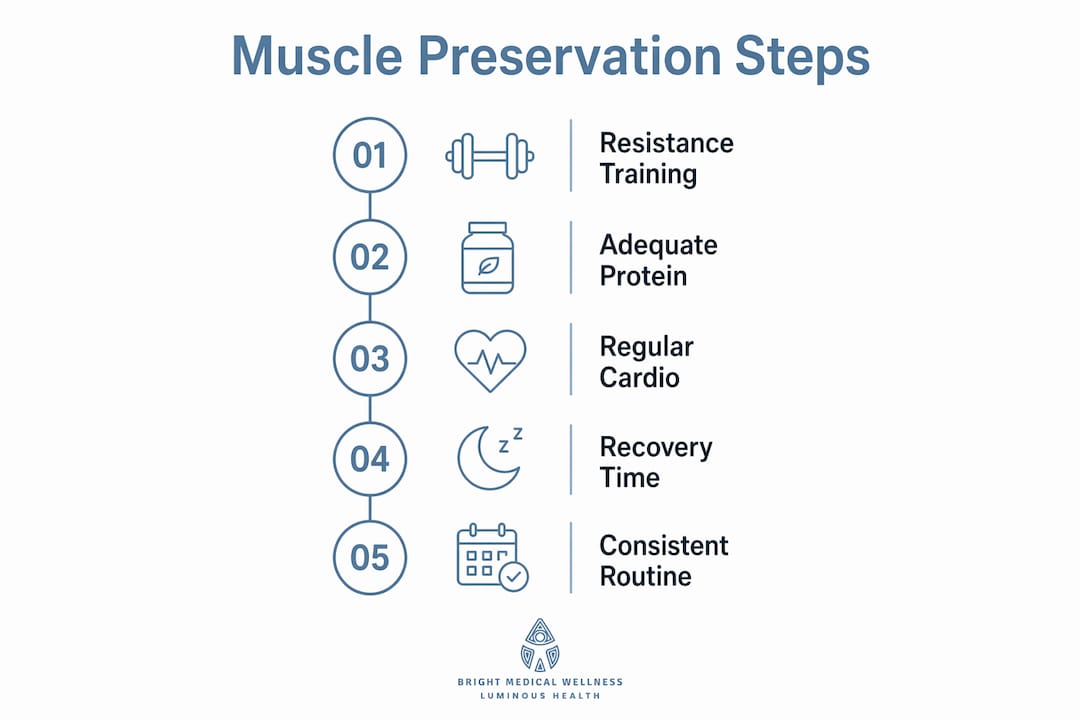
Muscle preservation requires 2–3 resistance training sessions per week, with the final 2–3 repetitions of each set feeling genuinely difficult. That level of effort signals the muscle to maintain itself even in a caloric deficit. Without that signal, your body treats muscle as expendable.
Key principles for exercise during active weight loss:
- Prioritize compound movements: squats, deadlifts, rows, and presses recruit the most muscle mass and produce the strongest metabolic response
- Pair resistance training with adequate protein within two hours of your session to maximize muscle protein synthesis
- Add walking as a daily baseline. A target of 7,000–10,000 steps per day supports calorie balance without the recovery demands of intense cardio
- Avoid the cardio-only trap. Running five days a week while eating at a deficit accelerates muscle loss, not just fat loss
Physical activity contributes more to weight loss maintenance than to active fat loss. That finding is counterintuitive but important. It means you should build the exercise habit early, not because it drives the scale down quickly, but because it is what keeps the weight off permanently.
Pro Tip: If you are new to resistance training, start with two full-body sessions per week using bodyweight or light resistance. Consistency over 8–12 weeks matters more than intensity in the first phase.
Which behavioral habits drive long-term adherence?
The strongest behavioral predictor of sustained weight loss is dietary self-monitoring. Self-monitoring adherence carries a pooled odds ratio of 2.34 for sustained weight loss. That means people who consistently track what they eat are more than twice as likely to maintain their results. No single exercise intervention comes close to that effect size.
Here is a practical behavioral framework for long-term adherence:
- Use validated tracking tools. Apps like Cronometer, Lose It!, and MyFitnessPal have verified food databases. Accuracy matters. Inaccurate tracking produces inaccurate results.
- Set SMART goals at each phase. Specific, Measurable, Achievable, Relevant, and Time-bound goals reduce decision fatigue and keep you oriented when motivation drops.
- Plan for plateaus explicitly. A plateau is not a sign the plan is broken. It is a sign your metabolism has adapted. Adjust your protein intake, change your training stimulus, or take a one-week diet break at maintenance calories.
- Build a support network. Whether that is a registered dietitian, a training partner, or a structured program, external accountability consistently outperforms solo willpower.
“The people who succeed long-term are not the ones with the most discipline. They are the ones who built systems that make the right choice the easy choice.” This principle applies directly to weight loss: structure your environment, your schedule, and your tracking tools so that adherence requires less effort, not more.
Mindfulness practices also reduce emotional eating, which is one of the primary drivers of relapse. Apps like Headspace or Calm take ten minutes per day and produce measurable reductions in stress-driven food consumption over 8–12 weeks.
How do longevity diets compare for sustainable weight loss?
Not all healthy eating patterns produce the same results for long-term weight management and aging. Three dietary frameworks have the strongest evidence base for adults focused on longevity.
High adherence to quality dietary patterns such as the Alternative Healthy Eating Index increases the odds of healthy aging by 1.45 to 2.24 times over a 30-year follow-up across 105,015 participants. That is one of the largest and longest dietary studies on record.
| Dietary Pattern | Core Focus | Longevity Evidence | Flexibility |
|---|---|---|---|
| Mediterranean Diet | Olive oil, fish, vegetables, legumes, whole grains | Strong: cardiovascular and all-cause mortality reduction | High: adaptable to most food cultures |
| Longevity Diet (Valter Longo) | Plant-forward, low protein in midlife, fasting-mimicking cycles | Moderate: strong in animal and observational data | Moderate: requires planning |
| Alternative Healthy Eating Index | Nutrient quality scoring across all food groups | Strong: 30-year cohort data on healthy aging | High: not prescriptive, pattern-based |
The Mediterranean diet stands out not just for its nutritional profile but for its social and cultural eating practices. Shared meals, slower eating, and reduced stress around food are built into the pattern. Those factors reduce cortisol, which directly affects fat storage and metabolic health.
For practical purposes, the Mediterranean diet is the most accessible starting point for most adults in the United States. You can find its core foods in any grocery store and adapt it to your existing cooking habits without a complete overhaul. You can explore more about longevity-supporting strategies to understand how these dietary patterns fit into a broader lifestyle framework.
Key takeaways
A longevity-focused weight loss plan works when it combines realistic caloric targets, high-quality nutrition, resistance training, and consistent behavioral tracking from the start.
| Point | Details |
|---|---|
| Set a realistic deficit | Lose 1–2 pounds per week with a 500–750 calorie daily deficit to protect muscle and metabolism. |
| Prioritize fiber and protein | Eat 25–29 grams of fiber and 1.2–1.6 g/kg of protein daily to support fat loss and healthy aging. |
| Train with resistance | Complete 2–3 resistance sessions per week with sufficient effort to preserve lean muscle during fat loss. |
| Track your food consistently | Dietary self-monitoring more than doubles the odds of sustained weight loss compared to untracked eating. |
| Choose a sustainable diet pattern | Mediterranean and Alternative Healthy Eating Index patterns show the strongest long-term evidence for healthy aging. |
What i have learned about weight loss and longevity
Most people come to weight loss with a 90-day mindset. They want a plan that works by summer. That framing almost guarantees failure, not because the plan is wrong, but because the timeline is.
The adults who genuinely transform their health over time are the ones who stop treating weight loss as a project and start treating it as a permanent shift in how they live. That sounds abstract, but it is concrete in practice. It means building resistance training into your week the way you build in work meetings. It means eating 30 grams of protein at breakfast not because you feel motivated, but because it is Tuesday and that is what Tuesday looks like.
What I find most underappreciated in this space is the role of metabolic health as a leading indicator. The scale is a lagging indicator. Muscle mass, fasting glucose, resting heart rate, and sleep quality tell you whether your plan is working weeks before the scale does. Tracking those markers keeps you grounded when weight loss stalls.
The other thing I would push back on is the idea that you have to choose between enjoying food and eating for longevity. The Mediterranean diet proves that wrong. Eating well can be social, pleasurable, and deeply satisfying. The goal is not restriction. It is quality. You can learn more about why longevity matters and how a long-term perspective changes the way you approach daily health decisions.
— Bright
How Brightmedicalwellness supports your long-term weight loss goals
Building a sustainable weight loss plan that supports longevity requires more than willpower and a good meal plan. It requires clinical support, personalized structure, and tools that adapt as your body changes.

Brightmedicalwellness offers GLP-1 medication programs using Semaglutide and Tirzepatide for eligible clients. These medications reduce appetite, lower food noise, and support metabolic health, making it significantly easier to maintain the caloric deficit and dietary quality your longevity plan requires. Brightmedicalwellness pairs medication with guidance on nutrition, muscle preservation, and behavioral tracking. If you are ready to build a plan that goes beyond the next 90 days, Brightmedicalwellness is a practical next step.
FAQ
What is a longevity-focused weight loss plan?
A longevity-focused weight loss plan is a structured approach that reduces body fat while preserving muscle, supporting metabolic health, and reducing the risk of age-related disease. It combines realistic caloric targets, nutrient-dense eating, resistance training, and behavioral tracking.
How fast should i lose weight for long-term health?
The evidence-backed rate is 1–2 pounds per week using a 500–750 calorie daily deficit. Faster loss increases the risk of muscle loss and metabolic slowdown, both of which undermine long-term results.
Which diet is best for weight loss and longevity?
The Mediterranean diet and the Alternative Healthy Eating Index both show strong evidence for healthy aging. The Mediterranean diet is the most practical starting point for most adults due to its flexibility and accessibility.
How much protein do i need during weight loss?
Adults focused on muscle preservation during weight loss should target 1.2–1.6 grams of protein per kilogram of body weight daily, with at least 30 grams at breakfast to prevent morning muscle catabolism.
Does exercise help more with losing weight or keeping it off?
Physical activity contributes more to weight loss maintenance than to active fat loss. Start building the exercise habit early so it is in place when you transition from active loss to long-term maintenance.

